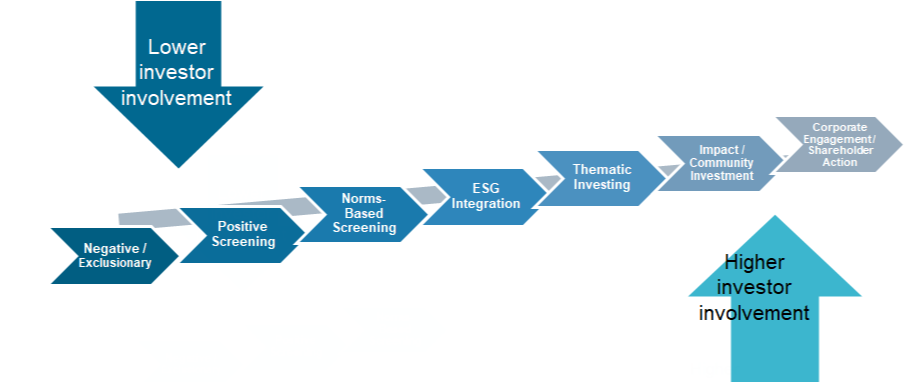
There are many strategies to help clients become more socially responsible. SRI is best seen as an umbrella term and can be thought of as a continuum from low to high investor involvement.
- Negative / exclusionary screening: Process of screening specific assets out of an investment strategy based sector, corporate governance, policies, or practices
- Positive / best-in-class screening: Investors select companies/sectors that set positive examples of environmentally friendly products and socially responsible business practices relative to industry peers
- Norms-based screening: Investigates the compatibility of potential investments and global norms as climate protection, human rights, working condition and action plans against corruption.
- ESG Integration: Systematic and explicit inclusion by investment managers of environmental, social and governance (ESG) factors into investment analysis process
- May use some “screening” but will generally go a step further than “do no harm” to directly investing in companies that have a positive societal impact
- Sustainability themed investing: Investment strategies focused on companies developing solutions to societal challenges such as renewable energy, climate change, women in leadership, etc.
- Impact / community investing: Targeted investments, typically in the private market, aimed at solving social or environmental problems
- Includes community investing, which is directing capital to traditionally underserved individuals or communities
- Corporate engagement and shareholder action: Use of shareholder power to influence corporate behavior; can include direct corporate engagement (communicating with senior management and boards), filing or co-filing shareholder proposals, and proxy voting.